
Everyone wants to build an AI SaaS in 2025, but only a few know the real playbook.
Building an AI SaaS feels like a complicated mission, right?
But here’s the surprising truth: more companies than ever are launching profitable AI-powered products this year. The AI-created SaaS market is set to reach $101.73 billion in 2025 and explode to $1.04 trillion by 2032.
Successful AI SaaS founders focus on one thing: solving a real problem with clean data and fast iteration.
This guide breaks down the exact steps from validating your idea to building your MVP to scaling your architecture like a pro. Whether you're a solo founder or leading a small team, you'll learn how to turn an AI concept into a real, revenue-generating product.
Before You Build AI SaaS: Understand This First
Most people think “AI SaaS” means adding a chatbot to any product. That’s why most AI tools flop.
Before you start building, you need absolute clarity on what you're actually creating.
An AI SaaS development is simply a software product with built-in intelligence. Unlike traditional SaaS, where features stay static, AI SaaS learns and improves with every use.
Think of tools like Jasper (AI writing), Copy.ai (workflow automation), or ChatGPT Plus. They don’t just do tasks; they do tasks faster, smarter, and more efficiently than a human could on their own.
At its core, the real magic of AI SaaS comes down to just three things:
- Automating repetitive work (ex, content creation, data analysis, lead scoring)
- Personalizing the user experience (ex, recommendations, tailored outputs)
- Revealing hidden insights (ex, predictive analytics, pattern detection)
And here’s the truth:
If your product doesn’t do at least one of these, it’s not AI SaaS - it’s just software with the word ‘AI’ slapped on it.
Step-by-Step Guide to Build an AI SaaS Product
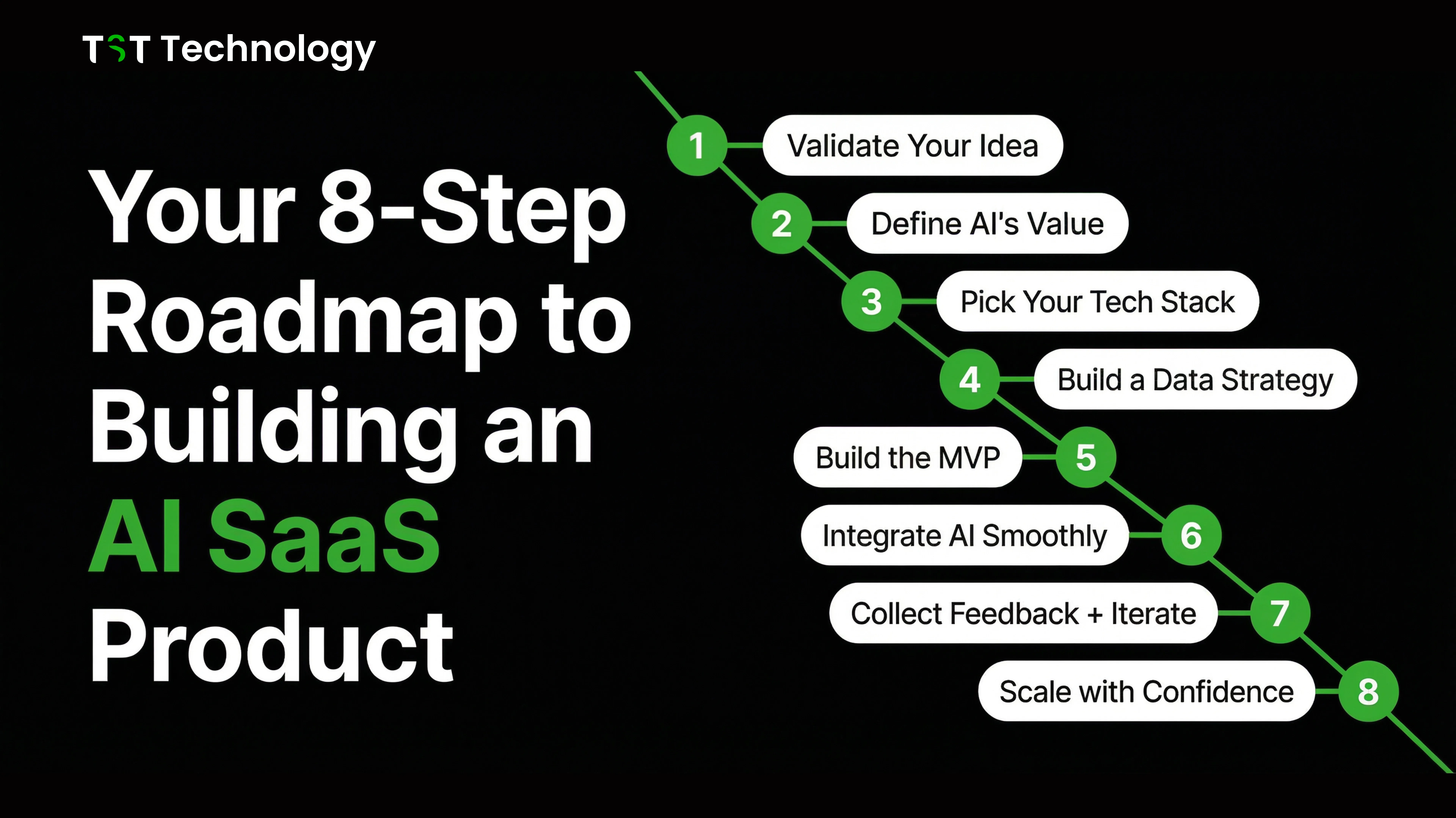
Step 1: Validate Your Idea (Before You Code)
This is where most AI SaaS founders get it wrong. They jump straight to building without testing if anyone actually wants their product.
Start with market research.
Spend 2–3 weeks identifying:
- What specific problem does your AI solve?
- Who's struggling with this problem the most?
- Are they willing to pay for a solution?
For example, Jasper, an AI writing tool, identified that marketing teams waste hours on content creation. That's the friction they targeted.
Talk to 15–20 potential customers in your target market. Ask:
- How do you currently solve this problem?
- What's the cost of doing it manually?"
- If a tool cut your time by 50%, what would you pay?
Document their answers. If 70%+ say they'd use something like this, you've got market fit potential. If not? Iterate your idea or pick a different angle.
Pro tip: Use Google Trends, Reddit communities, and ProductHunt to spot what people are actually asking for. Skip the guesswork.
Step 2: Define Your AI's Clear Value
Here's what separates winners from flops: clarity on what the AI actually does.
Too many startups say, "Our AI helps with marketing." That's vague. Jasper says, "Our AI generates on-brand marketing copy in seconds." That's specific.
Define:
- The core task your AI handles → Summarise customer support tickets (not help with customer service)
- The measurable outcome → Reduce onboarding time by 70% (does not improve onboarding)
- Who it's for → SaaS teams with 50+ customers (not everyone)
This clarity shapes everything downstream: your data needs, your MVP scope, even your pricing.
Real example: According to research from Verified Market Research, organizations using AI SaaS report an average 38.28% productivity increase.
Step 3: Choose Your Tech Stack
Your tech stack should be lean, fast, and AI-native.
AI/ML Layer (Your Brain)
- LLMs: OpenAI API, Anthropic Claude, or Cohere for instant language capabilities
- Fine-tuning: Hugging Face or Google Vertex AI if you need domain-specific models
- RAG (Retrieval-Augmented Generation): LangChain or LlamaIndex to connect AI with your data
- Vector Databases: Pinecone or pgvector (PostgreSQL) for storing and searching embeddings fast
Frontend (User-Facing)
- React or Next.js for scalable, responsive interfaces
- Tailwind CSS for rapid styling
- shadcn/ui components for pre-built AI interfaces
Backend (Your Engine)
- FastAPI (Python) or Express.js (Node.js) for lightweight APIs
- Celery or BullMQ for handling async jobs and model inference
- PostgreSQL for structured data
- AWS S3 or Google Cloud Storage for files
Infrastructure & DevOps
- Docker for containerization
- GitHub Actions or GitLab CI for CI/CD pipelines
- Vercel (frontend) or AWS Fargate (backend) for deployment
- Datadog or Sentry for monitoring performance and errors
Step 4: Master Your Data Strategy
Your AI Product is only as smart as the data feeding it. Garbage in = garbage out.
Five core steps to data preparation:
- Data Ingestion → Collect raw data from databases, APIs, CSVs, or external sources
- Cleaning → Remove duplicates, fix errors, handle missing values
- Labelling → Tag data so your model knows what's important (this is labour-intensive but critical)
- Transformation → Normalise formats, standardise fields, reshape for your model
- Validation → Check quality, spot outliers, verify schema consistency before feeding to AI
Practical example: If you're building an AI for financial risk detection, you can't just dump messy transaction data into your model. You need clean, consistent, properly labelled datasets where the AI can actually learn what "risky" looks like.
Pro tip: Start with a smaller, cleaner dataset. A model trained on 10,000 high-quality examples beats one trained on 1 million messy ones.
Step 5: Build Your MVP (Not the Whole Product)
Here's where speed matters. Your goal: Prove your AI creates value in 4–8 weeks.
What an MVP Includes:
- Core AI feature that solves the main problem
- Simple signup and login
- Basic dashboard showing results
- Export/integrate features your users need
- Feedback loop (thumbs up/down on AI outputs)
What It Doesn't Include:
- Admin panels
- Advanced analytics
- Enterprise integrations
- Compliance certifications (yet)
- Multiple AI models or workflows
Real case study: Jasper started with one use, generating blog outlines. It took weeks to perfect, not months to build "everything." They launched, listened to users, and expanded from there.
Strategy for launching fast:
- Use no-code/low-code tools initially (Bubble, Webflow + AI APIs)
- Skip custom UI work; use existing templates
- Integrate third-party APIs rather than build everything
- Deploy to production early; iterate based on honest user feedback
Step 6: Integrate AI Without Breaking Things
This is where many startups stumble. Wiring AI into your existing product feels like "performing surgery ": one wrong cut, and everything breaks.
Common integration headaches:
- AI responses are too slow (users abandon the feature)
- Your database can't handle the query volume
- The AI model crashes under load
- Outputs don't fit your existing UI
How to integrate smoothly:
- Start isolated → Build AI in a separate microservice, not embedded in your main code
- Use job queues → Don't make users wait for AI responses; process in the background with Celery or BullMQ
- Cache results → Store AI outputs so you don't recompute for the same input
- Version your API → Allow your AI endpoint to evolve without breaking existing integrations
- Monitor output quality → Track when AI performs poorly and retrain accordingly
Infrastructure pattern that works:
User request → API Gateway → Background job queue → AI model → Results stored → User sees result
This keeps your system responsive, even when AI inference takes 5–30 seconds.
Step 7: Collect Quality Feedback (and Iterate)
Once your MVP is live, the real work begins: making your AI actually useful.
Measure what matters:
- Output accuracy → Is the AI correct? (Thumbs up/down)
- User activation → What % try your AI feature?
- Retention → Do they come back to use it again?
- Time saved → How many hours does it actually save users?
Feedback loops to build:
- Thumbs up/down on every AI output (Jasper and Copy.ai do this)
- One-click "This is wrong, here's why" option
- Survey users: "Did this actually help?"
- Track which workflows users repeat (they're seeing value)
Use this data to improve:
- Retrain your model with user corrections
- Adjust prompts if outputs are off-brand
- Double down on workflows users love
- Kill features nobody uses
Step 8: Scale Confidently
Once you've hit product-market fit, it's time to grow without breaking.
Infrastructure Scaling
- Containerize everything (Docker) so you can spin up new instances instantly
- Use auto-scaling (Kubernetes or AWS Fargate) to handle traffic spikes
- Split services into microservices so one bottleneck doesn't take down the whole app
- Add caching layers (Redis) for frequently accessed data
Data Scaling
- Implement data versioning so that you can track model changes
- Set up MLOps practices, automated testing of data quality, and model performance
- Use feature stores (Feast, AWS SageMaker) for centralized feature management
- Monitor data drift (when real-world data diverges from training data)
Security & Compliance (Now Required)
- Implement SOC2 audit trail and encryption at rest/in transit
- Add SSO (Single Sign-On) for enterprise customers
- Build compliance dashboards (Vanta or Drata automates this)
- Document your AI's decisions for transparency
Common Pitfalls (And How to Avoid Them)
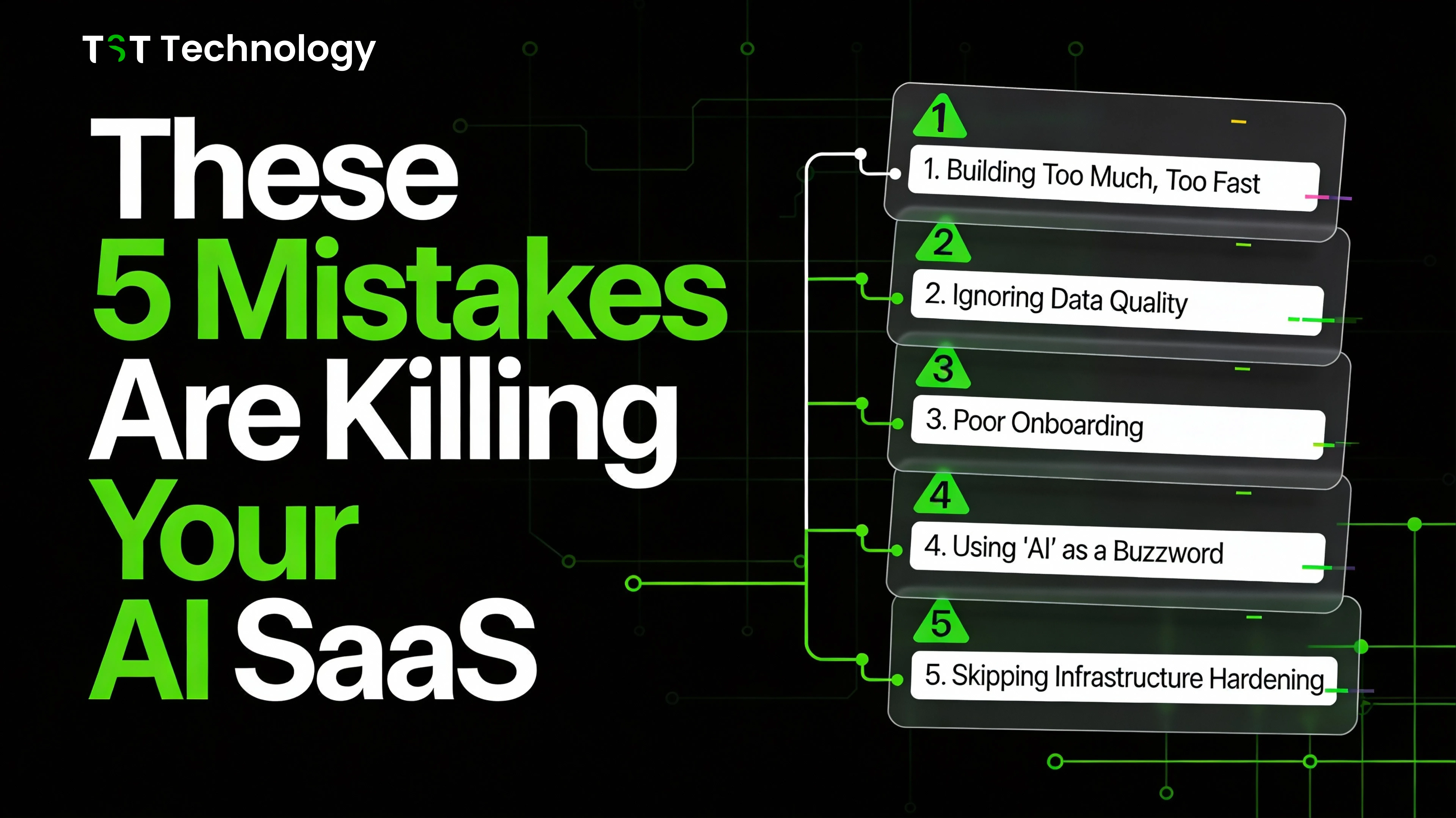
Most AI SaaS products don’t fail because of bad ideas; they fail because founders repeat the same avoidable mistakes.
Let’s break down the biggest traps (and the fix for each).
Pitfall #1: Building Too Much, Too Fast
Founders often ship five AI workflows before perfecting one. The result? A bloated product that confuses everyone.
Fix:
Focus on one core workflow. Nail it. Let early users validate it. Only then expand.
Pitfall #2: Ignoring Data Quality
Insufficient data can destroy your model faster than any code bug, yet most teams rush straight to model building.
Fix:
Follow the golden ratio:
40% data prep → 30% model → 30% UX.
Better data = better model = happier users.
Pitfall #3: Poor Onboarding
If users don’t understand how your AI works, they won’t stick with it, no matter how powerful it is.
Fix:
Create interactive walkthroughs, show value in under 30 seconds, and let advanced users skip tutorials when they want.
Pitfall #4: Using “AI” as a Buzzword
If your AI doesn’t save time, reduce effort, or surface insights, it’s just software with extra steps.
Fix:
Measure the value your AI truly delivers. Delete anything that doesn’t move the needle.
Pitfall #5: Skipping Infrastructure Hardening
Your MVP may run smoothly locally, but once 1,000 users hit it, everything breaks.
Fix:
Use Docker, set up CI/CD from day one, and add monitoring tools (like Datadog or Sentry) before you launch.
Real-World Examples That Actually Work
The fastest-growing AI SaaS products didn’t start big; they began by solving one painful problem better than anyone else.
Jasper (Writing AI)
Problem Solved: “Our team wastes 20 hours every week writing blogs and marketing copy.”
Focus: Brand-consistent content across multiple channels.
Result: Scaled to $1.5M ARR within months.
Copy.ai (Workflow Automation)
Problem Solved: “Our sales team spends hours scraping data and writing emails manually.”
Focus: Automation builders designed for non-technical teams.
Result: Huge enterprise adoption with plans priced at $249+/month.
Wooffer.io (AI Log Analysis)
Problem Solved: “Manually parsing and analyzing log files is slow and error-prone.”
Focus: AI-powered log analysis built for DevOps and engineering teams.
Result: Rapid adoption in the B2B SaaS ecosystem
Key Takeaways Before You Start
- Validate first, build second: Talk to 20 potential users before writing a single line of code.
- Solve one problem extremely well: Don’t build five workflow masters one.
- Prioritize data quality: The model is only as strong as the data behind it.
- Build fast, iterate faster: Launch your MVP in 8 weeks, then evolve with honest user feedback.
- Integrate intelligently: Use microservices + job queues so AI never slows your app.
- Track real value: Measure accuracy, retention, and time saved, not vanity metrics.
- Plan for scale early: Use Docker, CI/CD, and monitoring from day one.
Next Steps: Start Building Today
Stop waiting for “perfect timing.”
The AI SaaS market is booming, growing 39.4% annually through 2032, and your window to enter is wide open.
Here’s your 4-week action plan:
- This Week: Interview 5 users about their most significant pain points.
- Next Week: outline only your MVP's core features.
- Week 3: Choose your tech stack and build the foundation.
- Week 4+: Start coding and deploy your first live version.
For custom AI SaaS development and integration strategies, explore our service & Blog to learn how enterprise teams build scalable AI products.
You don’t need to be a genius. You don’t need millions in funding. You need a real problem, clean data, and the discipline to ship fast.
That’s how winners build AI SaaS in 2025.