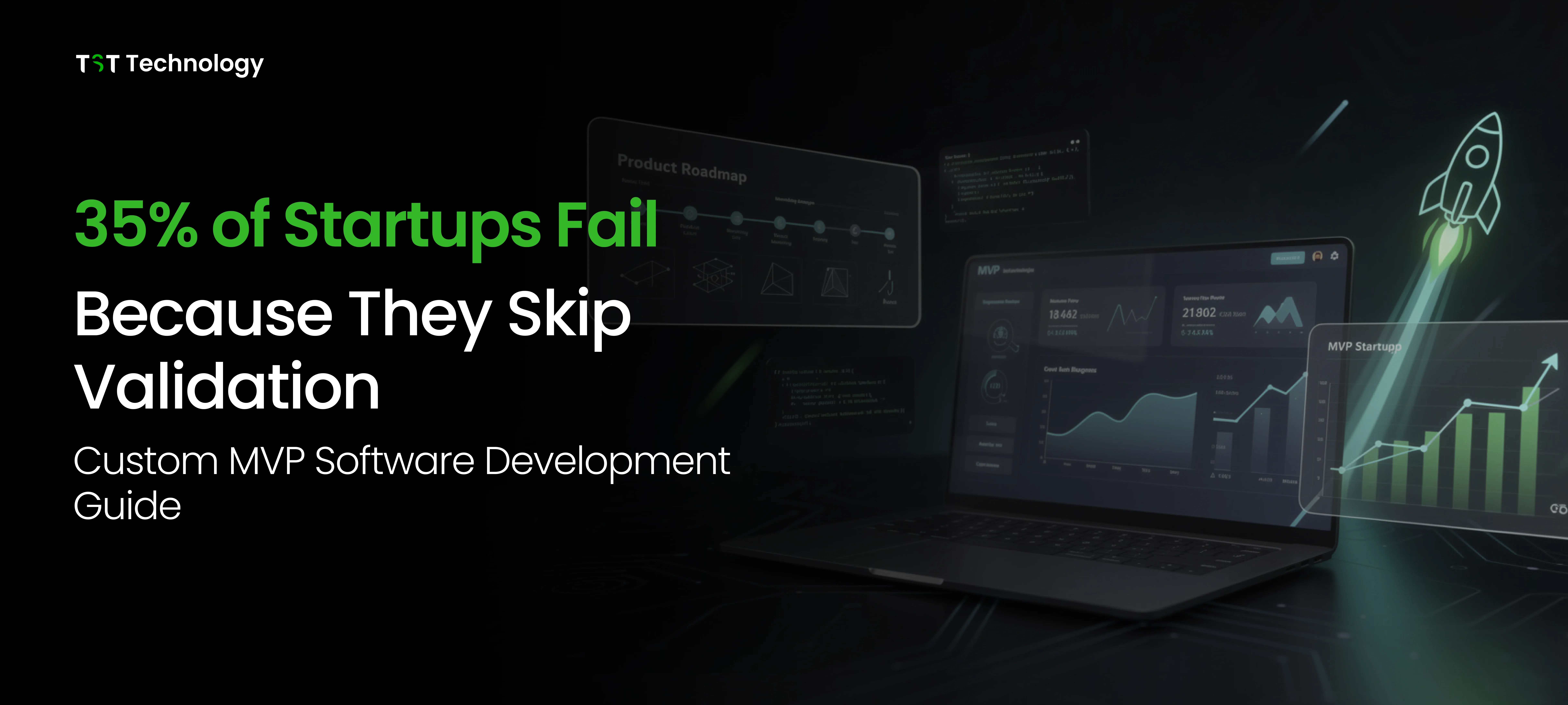

35% of startups fail because they build something nobody wants. That's not a typo. Nearly half of all startup failures are from one preventable mistake: skipping validation.
The custom MVP software development guide exists because founders keep learning this lesson the hard way. They invest months of development time and thousands of dollars into products that look great but solve problems that don't exist. Or they solve real problems in ways users don't care about.
An MVP, Minimum Viable Product, isn't about launching a half-finished product. It's about building the smallest possible version that lets you test your riskiest assumptions with real users. And "custom" matters because your business model, your users, and your competitive landscape are unique. Templates and no-code shortcuts might get you started, but they rarely get you to product-market fit.
This guide walks you through building a custom MVP from idea to launch. We'll cover the process step-by-step, the real costs (not agency fluff), where AI actually helps versus where it just adds noise, and how to choose a development partner who won't waste your time.
If you're a founder with an idea but no product yet, this is for you. If you've already started building and feel like you're flying blind, this is also for you. Let's dig in.
What Is Custom MVP Software Development?
Before you spend a rupee on development, you need to know exactly what you're building. The term MVP gets thrown around so much that it's lost its meaning. Let's fix that.
Understanding MVP in Software Development
An MVP is the simplest version of your product that delivers value to users and lets you learn what works. It has just enough features to solve the core problem for early adopters. Nothing more.
Dropbox's MVP was a video. They didn't build a file sync infrastructure first. They made a 3-minute demo showing how it would work. When 70,000 people joined the waiting list, they knew they were onto something.
Airbnb started with a website for renting air mattresses in their apartment. No payment system. No reviews. Just photos of their loft and a PayPal link.
Your MVP should answer one question: "Do people actually want this?" If you're building features that don't directly help answer that question, you're building too much.
What Makes an MVP "Custom" (Not Template-Based)?
An MVP template uses pre-built components, drag-and-drop builders, or white-label solutions. You customize colors and text. The underlying architecture stays the same.
A custom MVP is built for your specific use case from day one. The database schema matches your data model. The workflows match your user journeys. The tech stack supports your growth plans.
The difference shows up six months after launch. Template MVPs hit walls when you need custom features. Custom MVPs keep evolving because the foundation was built for your needs specifically.
| Aspect | Template MVP | Custom MVP |
| Time to launch | 2-4 weeks | 8-16 weeks |
| Upfront cost | $500-$5,000 | $10,000-$50,000+ |
| Flexibility | Lowlocked to template | Highbuilt for your needs |
| Scalability | Limitedoften requires rebuild | Designed for growth |
| Ownership | You license it | You own it completely |
| Best for | Testing concepts, simple tools | Validated ideas, complex workflows |
MVP vs Prototype vs Full Product
These terms are commonly misunderstood. Here is what they really mean.:
- Prototype: A clickable demo or mockup. No real functionality. Used to test UX concepts and get early feedback.
- MVP: A functional product with minimal features. Real users, real data, real transactions. Built to validate demand.
- Full Product: A complete solution with all the features your target market expects. Polished, scalable, ready for mainstream adoption.
Founders often build prototypes and call them MVPs. Or they build full products when they should have stopped at an MVP. Knowing which stage you're at saves time and money.
Why Choose Custom MVP Development Over Templates and No-Code?
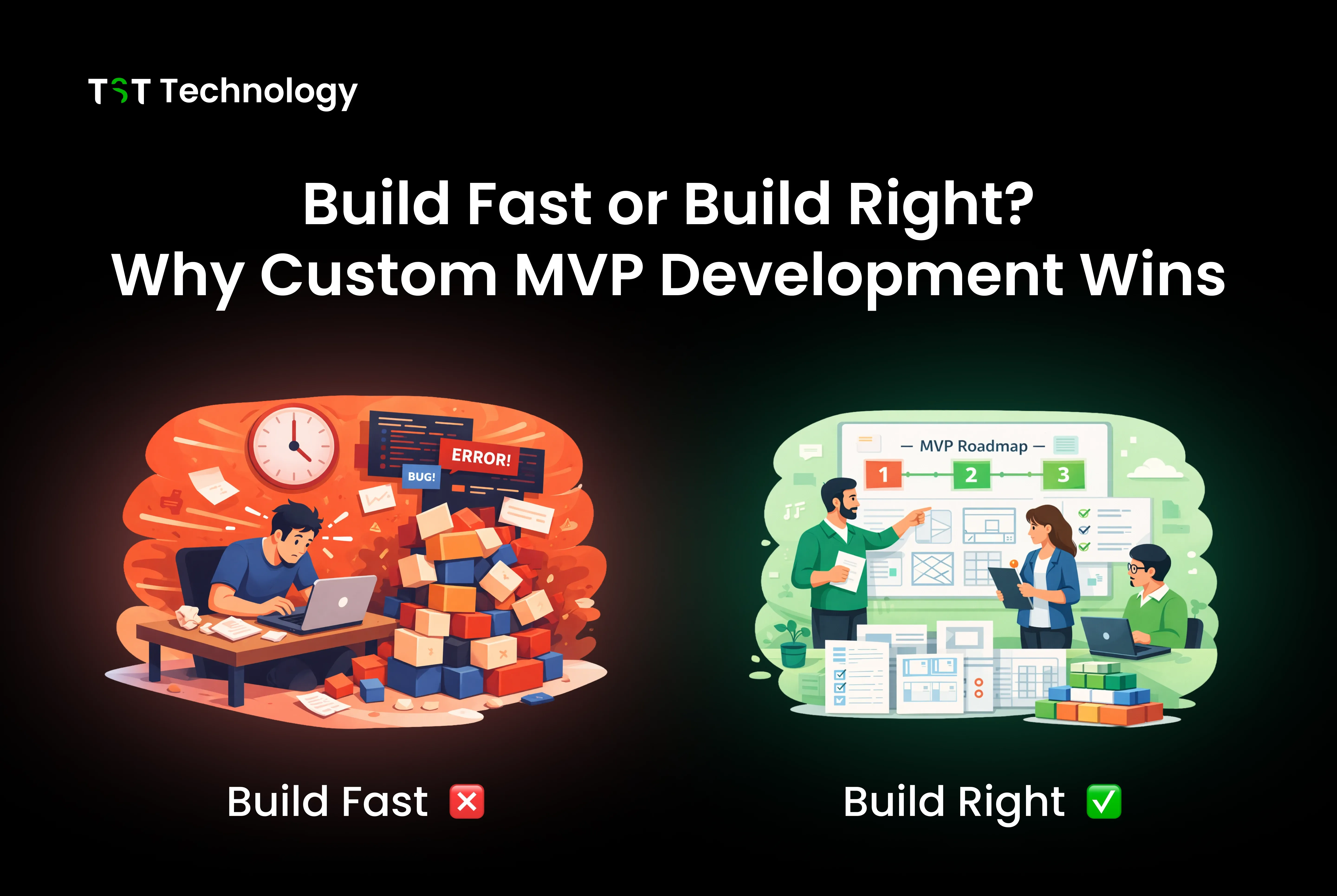
Every founder faces the build-versus-buy decision. Here's why custom development wins for serious startups.
The Limitations of No-Code and Template Solutions
No-code tools (Bubble, Webflow, Adalo) promise speed without developers. For simple apps, they deliver. But the limitations bite when you need to scale:
- Performance ceilings: No-code platforms run on shared infrastructure. As your user base grows, performance degrades.
- Feature constraints: You can only use the features the platform provides. If you need a custom workflow, you may not be able to build it.
- Data portability: Moving off a no-code platform often means rebuilding from scratch. Your data is trapped.
- Cost at scale: Cheap to start, expensive as you grow. Enterprise plans for no-code tools can exceed custom development costs.
Templates have similar problems. They get you live fast but force you into patterns that may not match your business model.
When Custom Development Pays Off?
Custom Software development costs more upfront but pays back in ways that matter. If you're still evaluating whether building your own product or relying on external platforms makes more sense long-term, this detailed comparison between custom software development vs third-party SaaS platforms explains the strategic differences founders should understand before committing.
- Ownership: You control the code, the data, and the product roadmap. There is no platform risk.
- Scalability: Built for your growth trajectory from day one.
- Competitive advantage: Features that templates can't offer become your moat.
- Technical debt control: Clean architecture from the start versus workarounds piled on workarounds.
If your goal is a lifestyle business generating $10K/month, a template might work. If you're building a venture-scale company, custom development isn't optional; it's essential.
Business Benefits of Custom MVP Development
The case for custom MVP development isn't just technical. It's business-critical.
Faster Time to Validated Learning
Custom MVPs seem slower to build, but often get you to validated learning faster. Why? Because you build exactly what you need to test your hypothesis. No template bloat. No workarounds. Just the features that validate your assumptions.
A founder we worked with spent three months customizing a no-code tool for a healthcare app. Compliance requirements forced so many workarounds that the product was fragile. We rebuilt it as a custom MVP in eight weeks. The difference: they could actually scale without hitting platform limits.
Scalability Without Technical Debt
Technical debt is the silent killer of startups. Every shortcut, every workaround, every "we'll fix it later" decision compounds interest. Templates and no-code solutions generate technical debt by design; you're fitting your business into someone else's architecture.
Custom development done right starts with clean architecture. The debt you take on is debt you choose, not debt forced on you by platform constraints.
Competitive Differentiation Through Unique Features
If you're using the same template as ten competitors, how do you stand out? Custom development lets you build features that are hard to copy. Unique workflows, proprietary algorithms, and integrations that competitors can't easily replicate.
Your MVP should demonstrate why you're different. That's hard when you're using the same building blocks as everyone else.
Long-Term Cost Efficiency vs Short-Term Savings
Custom development looks expensive at $30,000-$50,000 for an MVP. But compare that to the cost of a full rebuild when you outgrow your template. We've seen founders spend $20,000 on no-code development, then $60,000 rebuilding custom six months later when they hit platform limits.
Do it right once, or pay to do it twice. The math usually favors custom for serious startups.
The Custom MVP Development Process
Building a custom MVP isn't magic. It's a structured process that reduces risk and increases your odds of success.
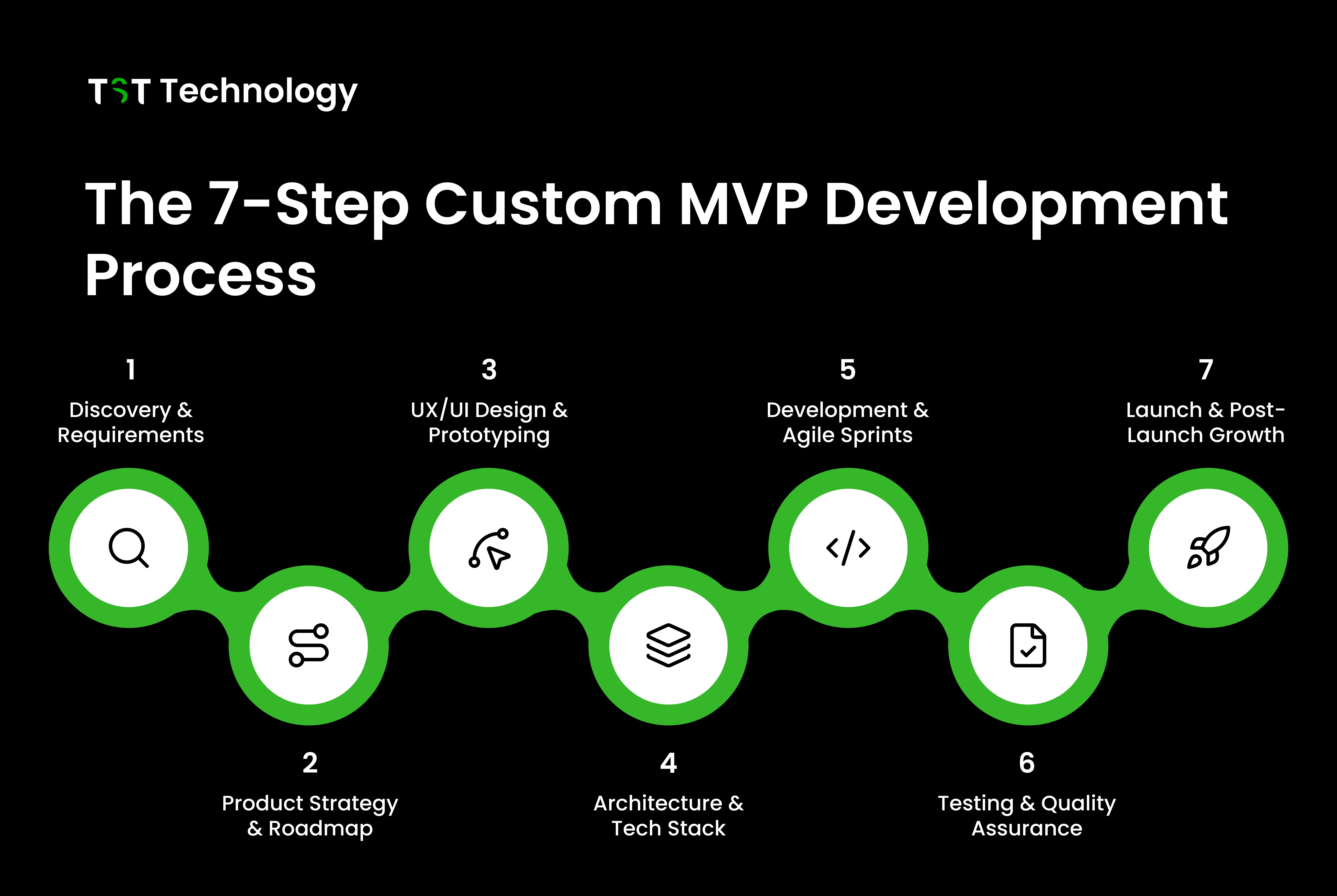
Phase 1: Discovery and Requirements Gathering
Before writing code, first understand what you are building and why. This step usually takes 1–2 weeks.
Key activities:
- User research: Talk to 10–20 potential users. Understand their problems. Don’t sell your idea, just listen to their pain points.
- Competitive analysis: Who else is solving this problem? How will you be different? What can you learn from their mistakes?
- Feature prioritization: Use the MoSCoW method (must have, should have, could have, won't have). Be ruthless. If a feature doesn't directly validate your core hypothesis, it's a "could have."
- Technical feasibility: What can be built technically? What is still unclear? Where are the possible risks?
Deliverable: A product requirements document (PRD) that defines what you're building, why, and what success looks like.
Phase 2: Product Strategy and Roadmap
With requirements clear, define your strategy for getting to market.
Key decisions:
- Platform: Web, mobile, or both? iOS first, Android first, or cross-platform?
- Tech stack: What technologies will you use? Consider team expertise, ecosystem maturity, and long-term maintainability.
- Monetization model: How will you make money? Freemium, subscription, transaction fees? The answer affects architecture.
- Launch strategy: Who will be your first users? How will you reach them? What is your plan for growth?
Deliverable: A product roadmap showing MVP scope, post-MVP features, and key milestones.
Phase 3: UX/UI Design and Prototyping
Design is not just about looks. It is about making things easy to use.
Key activities:
- User flows: Map the journeys users take through your product. Where do they start? Where do they end? What decisions do they make along the way?
- Wireframes: Rough sketches of screens showing layout and functionality. No colors, no fonts, just structure.
- High-fidelity designs: Polished screens showing exactly what the product will look like. These become the spec for developers.
- Prototyping: Clickable mockups that simulate the user experience. Test these with potential users before building.
Deliverable: Design files (Figma, Sketch) and an interactive prototype for user testing.
Phase 4: Architecture and Tech Stack Selection
With designs ready, plan the technical implementation.
Key decisions:
- Frontend framework: Choose between React, Vue, Angular, or another option. Think about your team’s skills and the ecosystem.
- Backend architecture: Monolith or microservices? For MVPs, monoliths are usually the right choice, simpler, faster to build.
- Database: SQL (PostgreSQL, MySQL) or NoSQL (MongoDB, DynamoDB)? The answer depends on your data model and consistency requirements.
- Hosting and DevOps: AWS, Google Cloud, Azure, or managed platforms like Heroku or Vercel?
- Third-party services: Authentication (Auth0, Firebase), payments (Stripe), analytics (Mixpanel, Amplitude), error tracking (Sentry).
Deliverable: Technical architecture document and technology choices with rationale.
Phase 5: Development and Agile Sprints
This is the stage where the product is developed. Building a custom MVP usually takes 8–16 weeks.
Key practices:
- Agile methodology: Work in 2-week sprints. Deliver working software in every sprint. Keep collecting feedback.
- Daily standups: 15-minute sync on progress, blockers, and priorities. Keeps the team aligned.
- Code reviews: Another developer reviews every line of code. This helps catch bugs early and keeps the code clean.
- Continuous integration: Automated testing on every code commit. Prevents broken code from reaching production.
Deliverable: Working software deployed to a staging environment for testing.
Phase 6: Testing, QA, and Iteration
Before launch, the product needs to work reliably.
Key activities:
- Functional testing: Does every feature work as designed? Test every user flow, every edge case.
- Performance testing: Does the app handle the expected load? Identify bottlenecks before users do.
- Security testing: Check for security risks. Run penetration tests if the system handles sensitive data.
- User acceptance testing (UAT): Have real users try the product. Watch where they get confused. Fix before launch.
Deliverable: Bug-free (or bug-minimal) product ready for production.
Phase 7: Launch and Post-Launch Support
Launch isn't the finish line. It's the starting line.
Key activities:
- Soft launch: Release to a limited audience first. Iron out issues before the full launch.
- Analytics setup: Track the metrics that matter. Activation rate, retention, conversion, know your numbers.
- Support infrastructure: How will users get support? Email, chat, or a knowledge base? Set up the right systems early.
- Iteration planning: Based on early feedback, what needs to change? Prioritize ruthlessly.
Deliverable: Live product with users, analytics, and a plan for iteration.
How Much Does Custom MVP Development Cost?
The question every founder asks. Here's the honest answer.
Cost Breakdown by Component
Component | Percentage of Budget | What It Covers |
| Design (UX/UI) | 15-20% | User research, wireframes, high-fidelity designs |
| Development | 50-60% | Frontend, backend, database, integrations |
| Project Management | 10-15% | Coordination, communication, planning |
| QA & Testing | 10-15% | Functional testing, UAT, bug fixes |
| DevOps & Infrastructure | 5-10% | Hosting, CI/CD, monitoring, security |
India vs Global Pricing Comparison
Development costs can change a lot depending on the location. Here is what you can expect.:
Region | Hourly Rate | MVP Cost Range (8-16 weeks) |
| India | $20-40 | $10,000 - $35,000 |
| Eastern Europe | $25-60 | $20,000 - $60,000 |
| Latin America | $25-60 | $20,000 - $60,000 |
| Western Europe | $40-110 | $40,000 - $200,000 |
| United States | $80-150 | $60,000 - $400,000+ |
Indian development teams deliver equivalent quality at 40-60% of US costs. The key is choosing the right partner; not all Indian dev shops are equal.
Factors That Drive Cost Up or Down
Cost drivers:
- Scope complexity: More features, more integrations, more cost.
- Design requirements: Custom illustrations, animations, and pixel-perfect design take time.
- Platform choices: Native iOS + Android costs more than cross-platform or web-first.
- Timeline pressure: Rush jobs cost more. Good developers are booked weeks out.
- Team location: As the table shows, geography matters.
Cost reducers:
- Clear requirements: Ambiguity leads to rework. A detailed PRD saves money.
- Prioritized scope: Build less, but build it right. Cut features that don't validate your hypothesis.
- Experienced team: Senior developers work faster and produce cleaner code. Worth the premium.
- Existing components: Using established libraries and frameworks versus building from scratch.
AI in MVP Development: Where It Helps and Where It Doesn't
Everyone is talking about AI. But how does it actually help when building an MVP?
AI Tools That Accelerate Development
- Code generation: GitHub Copilot, ChatGPT, and Claude can write boilerplate code, suggest implementations, and explain complex concepts. They don't replace developers but make them faster.
- Design assistance: AI tools can generate design variations, suggest color palettes, and create placeholder content.
- Testing: AI can generate test cases, identify edge cases humans miss, and automate regression testing.
- Documentation: AI excels at writing technical documentation, API docs, and user guides from code comments.
The Risk of Over-Engineering with AI Features
Many founders add “AI-powered” to their pitch decks. But most MVPs don’t need AI features.
When AI is appropriate:
- AI is core to your value proposition (e.g., an AI writing assistant)
- You're replacing an existing AI solution and need feature parity
- Users explicitly request AI features in interviews
When AI is premature:
- You are adding AI just to make the product sound impressive.
- The AI features solve problems users don't have
- You haven't validated that users want the non-AI version first
Build the simple version first. Add AI when user feedback proves it's necessary, not when it's fashionable.
How to Choose the Right MVP Development Company?
The right partner multiplies your odds of success. The wrong one wastes time and money.
Red Flags to Watch For
- No questions: They say yes to everything without asking why. Good teams challenge assumptions.
- Vague estimates: "It'll cost somewhere between $20K and $100K." Precise estimates require precise requirements.
- No portfolio: They can't show you similar work they've done. Either they're inexperienced or hiding something.
- Too cheap: If three quotes are $30K, $35K, and $8K, the $8K one is cutting corners you'll pay for later.
- Poor communication: Slow responses, unclear updates, or difficulty reaching decision-makers.
Questions to Ask Potential Partners
- "Walk me through your process from discovery to launch." Look for structured methodology, not vague hand-waving.
- “What is the biggest risk in this project, and how can we reduce it?” Strong teams plan for risks early.
- "Can I talk to a past client whose project faced challenges?" Everyone has happy clients. Good teams have happy clients even when things go wrong.
- "How do you handle scope changes?" Change is inevitable. The process for handling it matters.
- "Who will actually work on my project?" Some agencies pitch with senior talent, then staff with juniors.
Evaluating Portfolios and Case Studies
Don't just look at pretty screenshots. Dig deeper:
- Complexity: Is the work shown similar in complexity to your project?
- Results: Did the product launch successfully? Is it still active? What are users saying about it?
- Tech stack: Do they have experience with the technologies you're considering?
- Industry: Have they worked in your industry before? Domain knowledge helps speed up development.
Ask for references and actually call them. Ask about communication, deadline management, and how they handled problems.
Custom MVP Development Solutions from TST Technology
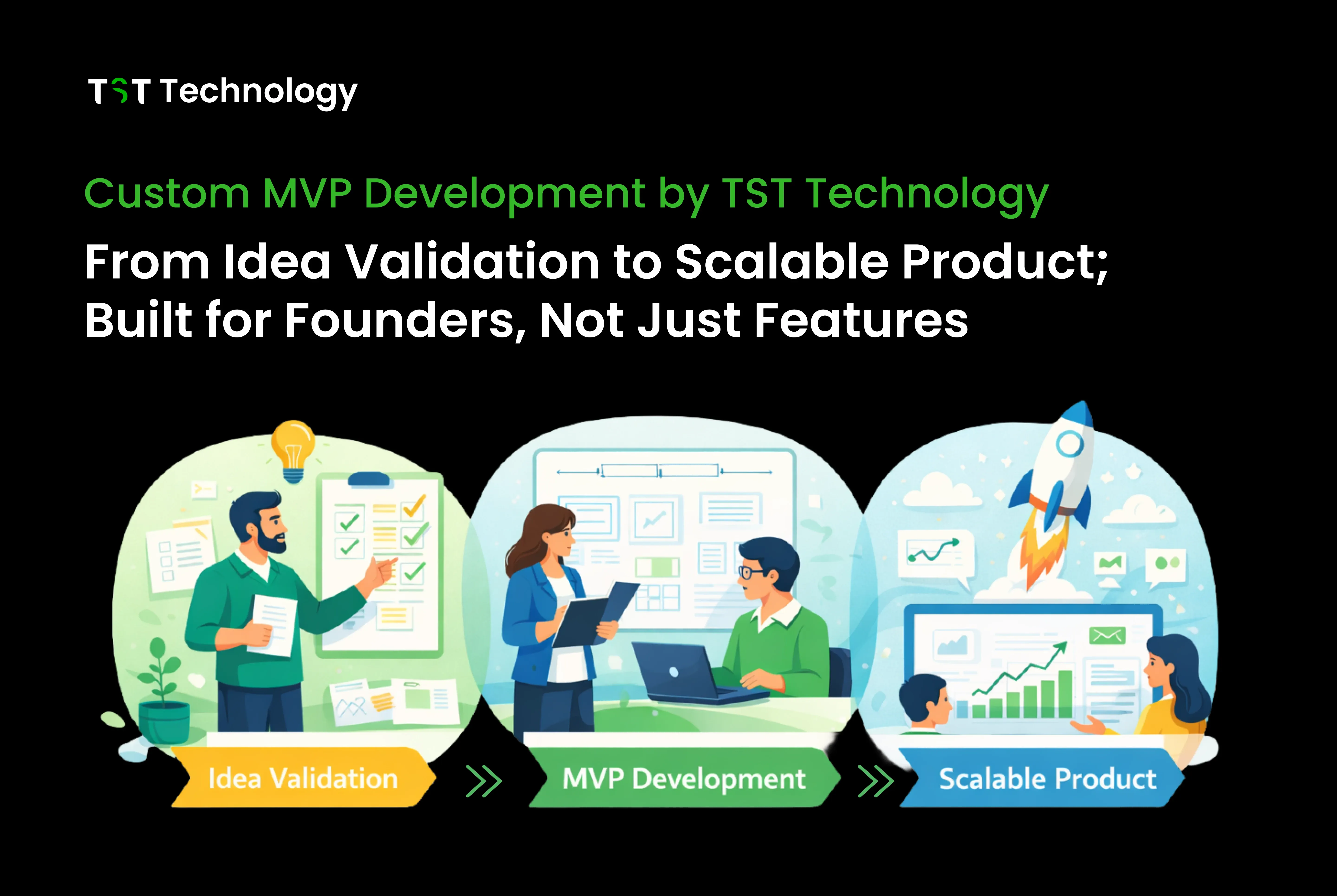
Choosing the right development approach is important. Choosing the right development partner is even more important. Many MVPs fail not because the idea is bad, but because the process lacks strategy, validation, and technical planning.
At TST Technology, custom MVP development is designed around one principle: build only what helps founders reach validated learning faster.
Instead of treating an MVP as a smaller version of a full product, the focus is on building a structured validation engine, something founders can launch quickly, learn from, and confidently scale.
A Founder-First Development Approach
Most agencies start with features. TST Technology starts with assumptions.
Before development begins, the team works with founders to identify:
- The riskiest business assumptions
- Core user problems worth validating
- Features that directly test market demand
- Metrics that define early success
This prevents overbuilding and ensures development effort directly supports product-market validation rather than unnecessary complexity.
End-to-End MVP Development, Not Just Coding
Custom MVP development involves more than writing code. Successful launches require alignment between product strategy, design, engineering, and scalability planning.
TST Technology supports founders across the full lifecycle:
- Discovery & Product Strategy
Clarifying business goals, defining MVP scope, and creating structured product roadmaps. - UX/UI Design & Prototyping
Designing intuitive user journeys and validating concepts before development begins. - Scalable Architecture Planning
Building clean, modular systems that evolve into full products without expensive rebuilds. - Agile Development & Rapid Iteration
Shipping working features in short sprints so founders can gather real user feedback early. - Launch & Post-MVP Support
Helping teams analyze user behavior, prioritize improvements, and plan the next growth phase.
Built for Scalability From Day One
Many startups rebuild within the first year because early technical decisions limit growth. TST Technology approaches MVP architecture differently.
Every MVP is designed to support:
- Future feature expansion without rewriting core systems
- Performance optimization as user adoption grows
- Integration with third-party services and APIs
- Smooth transition from MVP to production-scale product
This reduces technical debt and protects early investment.
Experience Across Startup and SaaS Ecosystems
TST Technology works with founders building SaaS platforms, AI-powered products, internal business tools, and marketplace applications. The experience of working across different industries helps teams anticipate common scaling challenges before they become problems.
Instead of delivering static software, the goal is to help founders build adaptable digital products that evolve alongside their business models.
When TST Technology Is the Right Fit?
Custom MVP development with TST Technology works best for founders who:
- Have validated a real problem and want to move toward product-market fit
- Need a scalable architecture rather than temporary solutions
- Want strategic guidance alongside development execution
- Plan to grow beyond an initial prototype into a long-term product
If your goal is simply launching something quickly at the lowest possible cost, templates or no-code tools may be sufficient. But if you’re building a product designed to scale, investing in a structured custom MVP approach becomes critical.
If you want expert clarity on scope, architecture, and development strategy before you start, you can schedule a discovery call with our MVP experts to discuss your product idea and next steps.
Practical Checklist for Founders Before Starting MVP Development
Use this checklist to assess your readiness before engaging a development partner.
Problem Validation Checklist
- I've identified a specific problem that real people have
- I've talked to 10+ potential users about this problem
- People have confirmed this is a problem worth paying to solve
- I understand how people currently solve this problem (workarounds, competitors)
- I can explain my solution in one sentence
Solution Clarity Checklist
- I know the core features needed for the MVP (not nice-to-haves)
- I can prioritize features based on user needs, not personal preference
- I have rough wireframes or sketches of key screens
- I've tested my concept with potential users (even informally)
Technical Foundation Checklist
- I've decided on web vs mobile vs both
- I know what integrations I need (payments, auth, analytics, etc.)
- I understand any compliance requirements (GDPR, HIPAA, etc.)
- I've identified the riskiest technical assumptions
Post-Launch Planning Checklist
- I have a plan for collecting user feedback
- I know how I'll prioritize feature requests
- I've thought about support and onboarding for early users
- I have a roadmap sketch for v2 features (post-validation)
Partner Readiness Checklist
- I've evaluated at least 3 development companies or freelancers
- I've seen relevant portfolio work or code samples
- I've spoken with past clients (references)
- I understand their process, timeline, and communication style
Scoring:
- 16-20 checks: You're ready. Move fast while momentum is high.
- 11-15 checks: You're mostly ready. Address the gaps before committing the budget.
- 6-10 checks: You're at risk. Spend more time on validation before building.
- Under 6 checks: You're guessing. Do customer discovery before spending on development.
Key Takeaways
- According to the CB Insight report, 35% of startups fail due to building products nobody wants. Validate before you develop.
- Custom MVPs cost $15K-$50K in India versus $50K-$200K+ globally, with equivalent quality.
- The MVP development process follows 7 clear phases from discovery through launch.
- AI accelerates development, but it rarely belongs in your first product version.
- The right development partner multiplies your success odds; choose based on process, not just price.
- Templates and no-code work for testing concepts, but custom development wins for venture-scale startups.
- Start by understanding the problem, not the solution. Speak with users before involving developers.
Conclusion
Building a startup is hard. Building the wrong product makes it impossible.
A custom MVP cannot guarantee success. Nothing can. But it helps reduce the risk of costly failure. You can test your ideas with real users before spending all your money. It gives you real data instead of guesses.
The founders who win aren't the ones with the best ideas. They're the ones who validate fastest, learn fastest, and adapt fastest. A well-built MVP is your engine for that validation.
The single most important takeaway is this: start with the problem, not the solution. Talk to users before you talk to developers. Define success metrics before you define features. Build only what you need to learn what works.
If you're planning a product and want clarity on approach, scope, and budget, book a discovery call with an expert. We'll ask hard questions, give honest feedback, and help you figure out whether an MVP makes sense for your situation.
No pitch. No pressure. Just clarity about what it takes to build something people actually want.