
What if you could handle 3x more customers without hiring 3x more people?
Growing a SaaS business is exciting, but it also creates problems. As your product grows, your support inbox fills up, your sales team spends too much time on admin work, and your developers struggle to keep up with feature requests. Hiring more people feels like the only solution, but it increases costs and slows growth.
This is where AI automation helps. AI allows your SaaS to handle more work without adding more team members. It can manage support queries, automate sales tasks, and free your team to focus on meaningful work. Many SaaS companies already use AI to reduce costs, respond faster to customers, and scale smoothly.
This guide shows how you can do the same, where to use AI, how to measure results, and how to start.
Why AI Automation is Critical for SaaS Scaling?
The SaaS market is moving fast. Global SaaS spending is projected to reach $ 1,131.52 billion by 2032. Manual processes that worked when you had 100 customers don't scale to 10,000 customers, at least not without burning out your team.
Here’s what AI automation really does. It takes repeated tasks away from your team. This lets them focus on important work that actually grows the business. Unlike hiring new people, which takes months and costs a lot every month, AI can scale almost instantly. If you're looking to build AI into your product from the ground up, explore our AI-powered SaaS development services.
The results are clear. Support teams using AI handle more customer questions in less time. Sales teams save several hours every week by avoiding manual work. Developers ship features faster with AI help. For SaaS companies with small teams, this can mean the difference between steady growth and complete burnout.
The Hidden Costs of Manual Processes
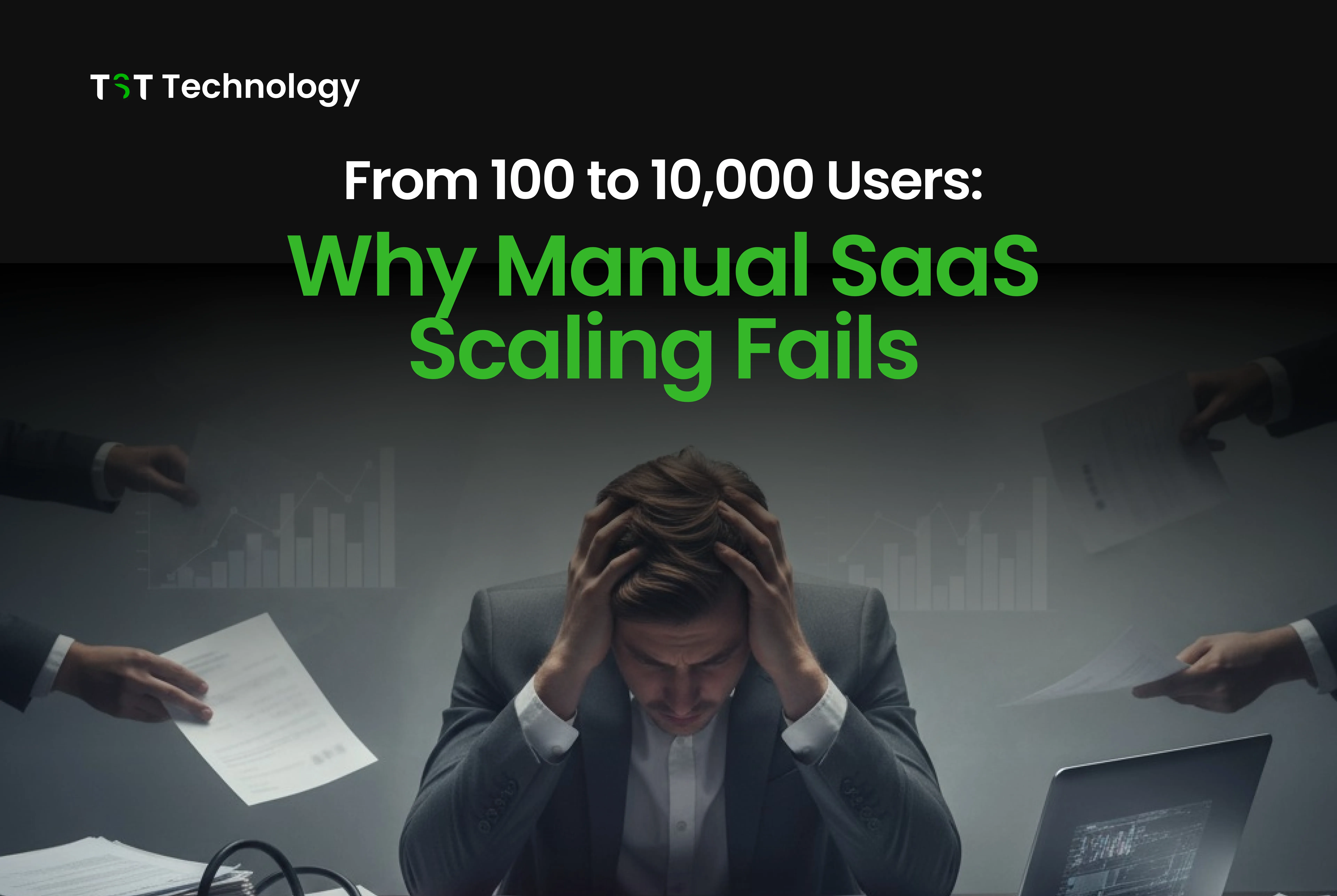
Most SaaS founders don’t see how much money they lose because of manual work. It’s not just salaries. It’s the lost time and missed chances. When your team spends hours on repeated tasks, they can’t focus on what really matters. They can’t build better features, improve customer retention, or find upsell opportunities. A support agent answering the same billing questions all day can’t handle challenging issues that make customers happy.
When a sales rep spends time on data entry, they are not talking to leads or closing deals. When a developer writes basic code, they are not solving critical problems that make your product better. AI automation does more than save money. It removes this extra work from your team. This lets your best people focus on meaningful work. That shift in focus is often more valuable than the money you save.
Key Areas Where AI Automation Drives Results
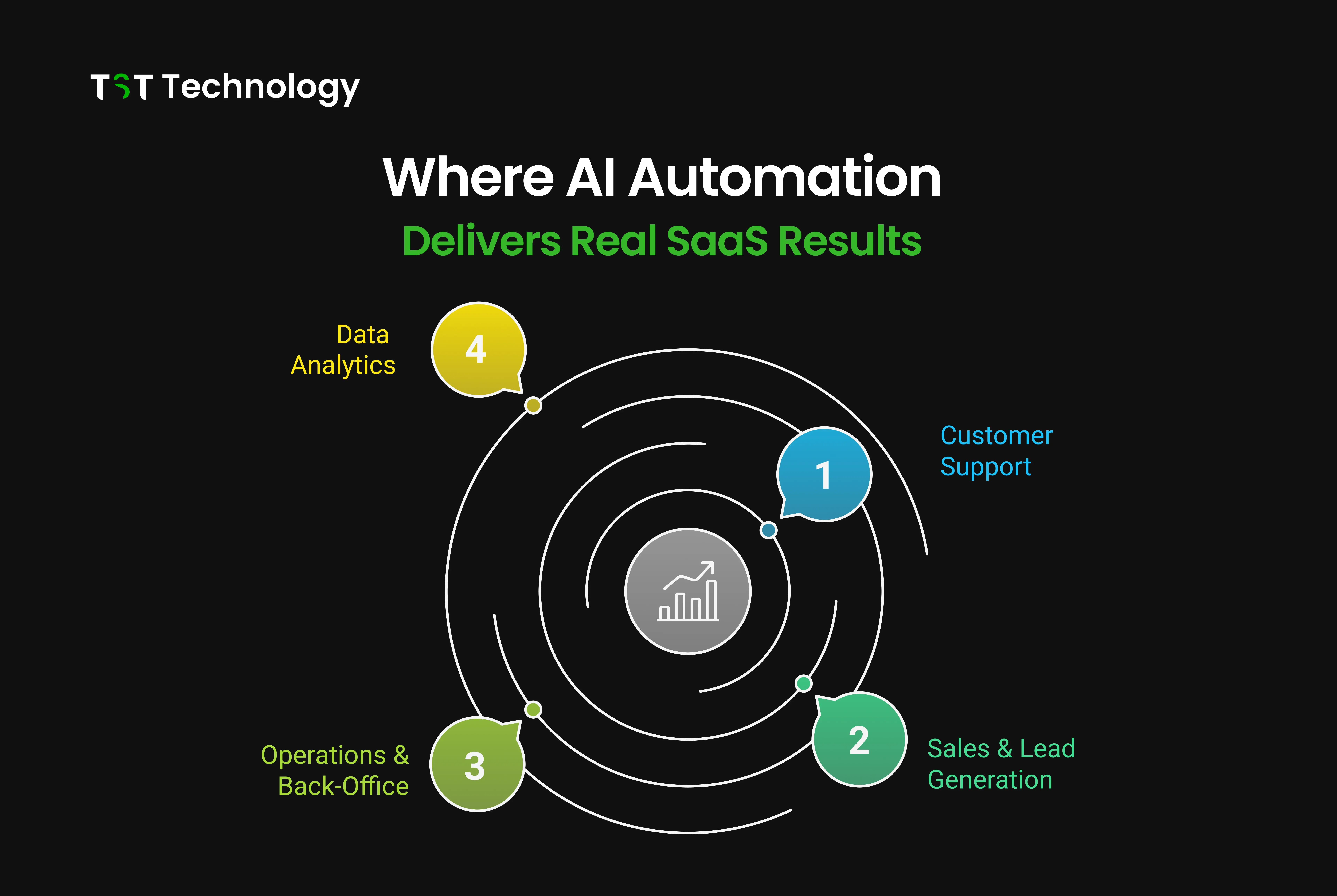
1. Customer Support & Success: The Quick Win
Customer support is usually the first place SaaS companies feel the cost pressure. Every ticket costs money, and scaling support headcount is expensive.
AI-powered chatbots and support automation are game-changers here. These systems can handle 65-70% of routine inquiries instantly, such as password resets, billing questions, and basic troubleshooting. That's not a small number. When you deflate 70% of tickets automatically, your support team focuses on complex issues where they actually add value.
The results speak for themselves:
- Response time: AI reduces first response times by 37%.
- Resolution speed: Issues get resolved 44% faster with AI assistance.
- Customer satisfaction: 80% of customers report positive experiences with AI-powered support.
A real-world example: Iron Mountain deployed Salesforce's Einstein AI in its service operations. The AI generates personalised case replies based on past cases and its knowledge base.
The result? 76% of AI-generated responses needed zero editing before sending. Chat abandonment rates dropped from 5% to just 1.5%.
The strategy: Start with your top 10-15 most common customer questions. Build an AI chatbot to handle these first, then expand.
2. Sales & Lead Generation: Stop Wasting Pipeline
Sales teams are spending too much time on busywork. Data entry, lead qualification, and follow-up emails can take up 60% of a sales rep's day. AI automation frees them up to actually talk to prospects.
Here's what AI does best in sales:
- Lead scoring: AI learns which prospects are most likely to buy by analysing historical data. This lets reps focus on high-intent leads instead of guessing.
- Personalised outreach: AI drafts personalised emails at scale, dramatically improving response rates.
- Predictive insights: AI flags deals at risk of closing and suggests next steps.
- Automated follow-ups: No more missed opportunities from forgotten follow-ups.
The impact is substantial. B2B SaaS companies using AI automation see:
- 22% increase in conversion rates
- Up to 30% increase in sales productivity
- 5-hour reduction in weekly admin work per rep
Real example: ZoomInfo implemented AI-driven sales tools and achieved a 22% increase in conversion rates through better lead prioritisation and personalisation.
3. Operations & Back-Office: The Efficiency Multiplier
Most SaaS teams have back-office chaos. Invoice processing, expense reports, payroll, and onboarding: these tasks take a lot of time and introduce errors. AI handles these beautifully because they're rule-based and repetitive.
What gets automated here:
- Data entry & enrichment: AI populates CRM fields automatically by analysing company websites.
- Invoice processing: Extract data, validate, and route invoices without human touch.
- Employee onboarding: Automate paperwork, software provisioning, and training workflows.
- Expense management: Classify expenses, detect fraud, and process reimbursements automatically.
The payoff: SaaS startups report 20-30% cost reduction just from AI-driven cloud optimisation alone.
4. Data Analytics & Insights: From Reactive to Predictive
Raw data is worthless. Insights are gold. AI turns one into the other automatically.
Instead of waiting for reports, AI:
- Continuously monitors key metrics (churn, MRR, NRR, customer health scores).
- Flag anomalies before they become big problems.
- Surface patterns (which customers are about to churn, which segments are most profitable).
- Recommends actions (which customers need outreach, where to invest next).
This shifts your team from reactive (responding to problems after they happen) to predictive (preventing problems before they start). That's how you scale by being smarter, not just bigger.
Your Implementation Roadmap: Start Small, Scale Smarter
Rushing into AI automation is the fastest way to waste money. Here's the proven approach:
Phase 1: Identify Your Quick Wins
Look for processes that are:
- Repetitive and rule-based
- Currently done manually
- Costing significant time or money
- Low risk if something goes wrong (don't start with critical billing systems)
For most SaaS companies, this is customer support automation. It's easy to measure, customers see immediate benefit, and success builds internal buy-in.
Phase 2: Pilot & Measure
Deploy AI to one team or use case. Define success metrics before you start:
- How much time does it save per person per week?
- What's the quality impact? (accuracy, customer satisfaction)
- What's the cost? (software + implementation time)
- What's the ROI?
Track everything. You'll use these numbers to justify scaling.
Phase 3: Gather Feedback & Iterate
Talk to the people using the tool. What's working? What's not? Does it need training data? Are there edge cases breaking it? This is where you perfect the implementation before scaling.
Phase 4: Scale & Expand
Once one team is successful, expand to others. Use what you learned to roll out faster. Maintaining platform stability as you scale requires proper SaaS maintenance and support to ensure uptime and performance.
If you’re not sure where to start, you don’t have to figure this out alone. If you want expert help to plan, build, or scale AI automation the right way, you can book a 1-on-1 consultation with our team.
We’ll review your current processes, find quick wins, and create a clear AI implementation roadmap for your SaaS.
Real-World Case Studies: Proof That This Works
1. Salesforce Customer Success: 52% Increase in Self-Service
Salesforce rebuilt its customer help portal using Einstein AI. The AI serves personalised knowledge articles based on each customer's purchase history and behaviour. The chatbot uses intent detection to provide answers without forcing customers to search manually.
Result: Self-help resolution rates jumped 20%, and they won the 2022 TSIA STAR Award for Innovation in Customer Portals.
2. Wiley: 213% ROI from Service Automation
Wiley implemented Salesforce Agentforce for customer service. AI agents handle common issues automatically. Einstein generates responses for reps, grounded in the knowledge base. Seasonal agent onboarding is 50% faster.
Result: 213% return on investment and $230,000 in direct savings.
Common Pitfalls & How to Avoid Them
Pitfall 1: Over-Automating Too Early
Using AI before fixing your process can cause problems. If the workflow is broken, AI will only make it worse. Fix the process first. Then automate it.
Pitfall 2: Ignoring Data Quality
AI works only as well as your data. If your data is messy or wrong, the results will be poor. Clean and organise your data before using AI.
Pitfall 3: Forgetting the Human Touch
AI cannot handle every situation. Some customers need human help. Always give users an easy way to talk to a real person.
Pitfall 4: Treating AI as “Set and Forget”
AI is not a one-time setup. It gets better with feedback and updates. Track performance, collect feedback, and improve it regularly.
Measuring ROI: How to Know It's Working
This is crucial. You need to prove that AI automation is actually helping.
Track these metrics:
Efficiency Metrics:
- Time saved per person per week
- Tasks completed per agent per day
- Cost per transaction (before vs. after)
Quality Metrics:
- Accuracy rate of AI-generated responses
- Customer satisfaction scores
- First-contact resolution rate
Business Metrics:
- Revenue impact (faster sales cycles, higher conversions)
- Cost savings (headcount reduced, overtime eliminated)
- Customer retention (better service = lower churn)
Related Resources
As you build out your scaling strategy, understanding your broader SaaS foundation is critical. Check out our saas development checklist to ensure you have the foundational elements in place before automating.
Also, explore the benefits of custom saas development to understand when custom solutions paired with AI automation create unique competitive advantages.
And if you're considering AI-specific development, learn more about AI agent development services to explore custom AI solutions tailored to your SaaS.
Conclusion
Scaling your SaaS with AI automation is no longer optional. It is necessary to survive and grow. The companies winning in 2025 are increasing productivity without hiring more people. No matter where you use AIsupport, sales, or operations, the approach stays the same. Find repeated tasks, start with one team, track results closely, and then scale.
The real question is not if you should use AI. Your competitors already are. The question is how fast you will act. Teams that start now will gain experience, clear results, and better processes while others fall behind.
Start now, and by Q1 2026, you'll have the data and confidence to scale AI across your entire operation.