
We are sharing something that most SaaS founders learn only after burning years of time, money, and confidence.
If you’re a founder trying to scale a SaaS product or planning to move from services to SaaS, the episode is not about hacks or overnight success. It’s about how real products actually grow.
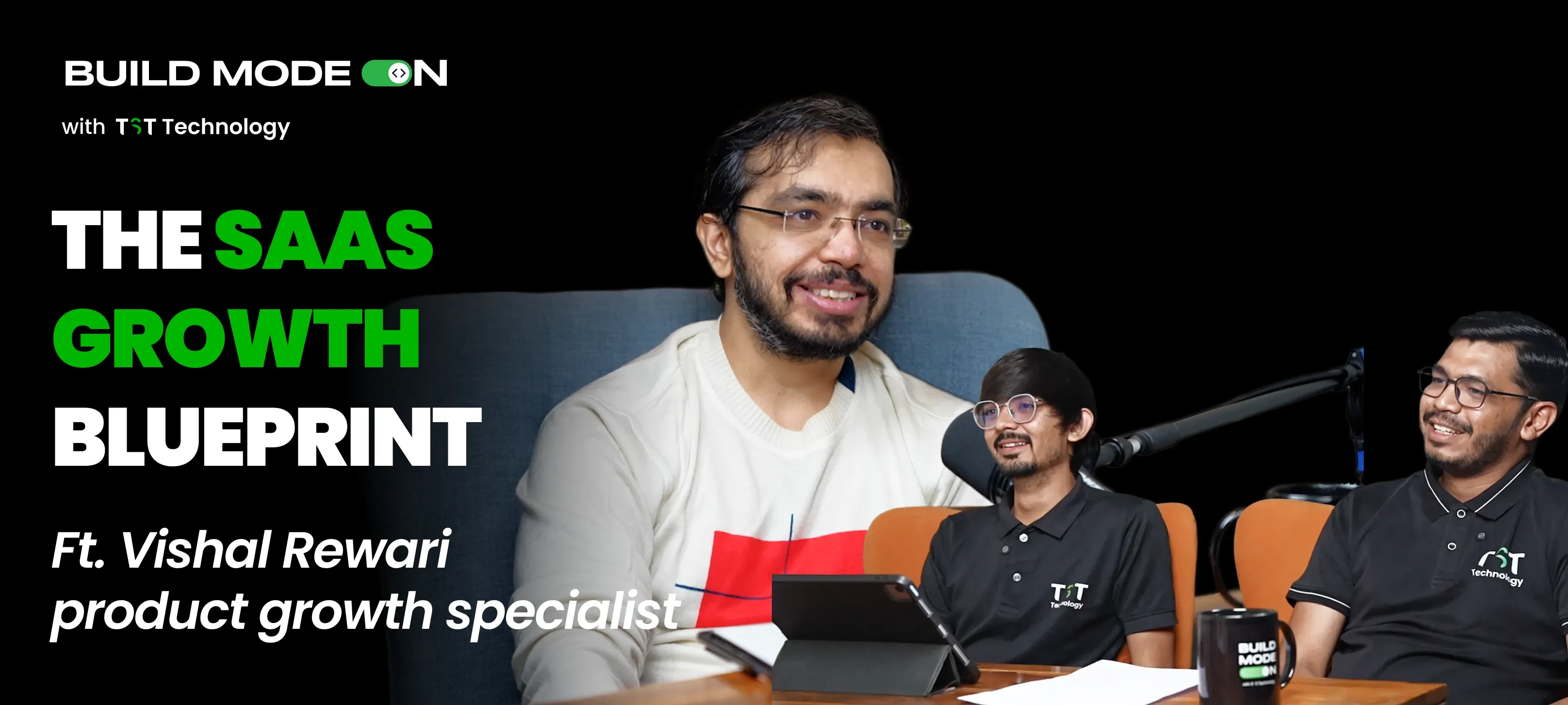
In this episode of Build Mode On with TST Technology, we sit down with Vishal Rewari, a product growth specialist who has worked with 80+ service companies and influenced products that have generated $350M+ in value.
Joined by Mr. Parth Makwana (PM), Founder & COO, and Mr. Hiren Kalariya, Co-founder & CEO of TST Technology. The conversation dives deep into SaaS growth realities from market selection and naming psychology to data systems, pricing, AI, and trust.
This episode is especially valuable for:
- SaaS founders struggling to find early traction
- Service company owners planning a product pivot
- Growth leaders are stuck between users and revenue
Watch the full episodes here: Watch on YouTube
Why Avoid Selling SaaS to Indian Customers Initially?
One of the most uncomfortable yet practical insights discussed in this episode is that selling SaaS in the Indian market can be more challenging during the early validation stage, based on Vishal’s experience.
Not because the market lacks intelligence, but because payment behavior, expectations, and ROI cycles make early validation difficult.
Early-stage startups are not Jio or Ambani. They need:
- Faster ROI
- Clear willingness to pay
- Software-mature buyers
That’s why Vishal advises targeting the US, Europe, or Australia for the first 10 customers.
The Importance of Product Naming Psychology
A compelling and memorable product name is a foundational aspect of successful SaaS marketing. Naming isn’t just about creativity; it’s a strategic exercise grounded in psychology and marketing science.
The ideal product name is:
- Concise: Preferably one word to enable instant recall.
- Descriptive or Suggestive: It should hint at the product’s function or value.
- Trust-Building: A name that inspires confidence and aligns with the product’s promise.
For example, the product “Wooffer” was named with multiple psychological factors in mind: it sounds like a dog’s bark (a guardian) and also relates to sound enhancement (improving backend processes). This dual significance helped create an emotional connection and trust among users.
When naming your MVP (Minimum Viable Product), test the name with your target audience by observing their reactions and recall ability. Avoid lengthy or complicated names that dilute brand recognition.
Service First, Product Next: A Practical Blueprint for SaaS Founders
Many successful SaaS founders don’t start with a product. They begin with services for good reason.
Before jumping into building software, understanding why a service-based model works and how to transition correctly can save founders years of wasted effort and capital.
Why Start with a Service-Based Model Before Building a Product?
For early-stage founders, services offer a powerful foundation before committing to full-scale product development.
Key Advantages of a Service-First Approach
1. Immediate Cash Flow
Services generate revenue from day one. This cash flow can:
- Fund product development
- Reduce dependency on investors
- Lower overall business risk
2. Deep Domain Understanding
Working closely with clients exposes:
- Real pain points (not assumed ones)
- Buying behaviour and objections
- Workflow inefficiencies are worth solving with software
3. Organic Intellectual Property Creation
Over time, service businesses naturally develop:
- Internal tools
- Proven frameworks
- Repeatable processes
These assets often become the core IP behind future SaaS products. Many global firms, such as Accenture, Deloitte, and Infosys, have followed this exact path, building scalable products by first solving problems through services.
Strategic takeaway: Services let founders play to their strengths while learning the market with real money on the line.
Service Model vs. Product Model: Choosing the Right Starting Point
Starting with services doesn’t mean you lack ambition for SaaS. It means you’re choosing leverage over assumptions.
The Critical Insight: People Don’t Want Tools, They Want Outcomes
Modern buyers don’t care about:
- Dashboards
- Feature lists
- Technical elegance
They care about:
- Booked meetings
- Closed deals
- Time saved
- Revenue generated
This mindset shift has created a new category often called “Service as a Software” where customers pay for results, not software access.
The Dangerous Middle: Why Most Founders Fail the Transition
Many founders understand the theory but fail during execution.
Common mistakes include:
- Building a product too early
- Chasing large markets without proof
- Ignoring existing customer trust
- Creating software disconnected from real workflows
The problem isn’t the idea. It’s careless execution.
Transitioning from Service to Product: The Right Way
To successfully transition from services to SaaS, two rules are non-negotiable.
Rule #1: Play to Your Strengths
Build products where your expertise already exists.
- If you run a web development agency → build tools for faster delivery, QA, or deployment.
- If you offer SaaS consulting → productize audits, dashboards, or onboarding systems
Don’t chase new fields just because they look profitable. Go deep into what you know. That works better than trying something new.
Rule #2: Leverage Your Existing Network First
Your first 5–10 customers should not be strangers.
Start with:
- Existing clients
- Past partners
- Industry peers who already trust you
These early users:
- Give honest feedback
- Forgive early imperfections
- Help validate pricing and positioning
Leveraging Data and Metrics for SaaS Growth
“You cannot improve what you cannot measure.”
From day one, every SaaS product must track three critical data points:
- Where did the customer come from? (Attribution)
- What did the customer do? (Product behaviour)
- What brings them back? (Retention & aha moments)
Most startups fail not because of a lack of users but because of poor data systems.
Tools That Actually Matter
- Attribution: UTMs, Branch, Adjust
- Analytics: Mixpanel, Amplitude
- Engagement: WebEngage
Without these, decision-making becomes guesswork.
Optimising ROI Across Development, Marketing, and User Engagement
Return on Investment (ROI) remains the ultimate metric to justify every dollar spent on product development, marketing, or user engagement. However, many startups struggle to accurately measure ROI because systems for tracking campaign effectiveness may be missing or improperly configured.
They track too many irrelevant metrics, leading to analysis paralysis. Underestimating the effort required to implement robust analytics. The solution lies in focusing on key revenue-driving flows, having measurable KPIs, and continuously optimising based on data. A clear understanding of ROI allows companies to pivot quickly, invest in high-impact areas, and avoid wastage.
AI in SaaS: Powerful, but Dangerous Without Control
AI should not replace thinking. It should accelerate insight.
Vishal introduces the Criticality–Complexity Framework:
- Focus on use cases with high impact, low complexity
- Always keep a human in the loop
- Never let AI push autonomous production changes
AI dashboards that allow natural-language questions are powerful, but judgment remains human.
Not sure which AI use cases are right for your product? Our AI SaaS development consulting can help you define the right strategy.
The Core Pillar of SaaS Growth: Trust
Everything comes back to one truth: Business is about trust.
Users decide in seconds:
- Does this product understand me?
- Can I trust this company?
Trust is built through:
- Clear demos
- Strong partnerships
- Transparent pricing
- Solving one problem exceptionally well
Without belief, no SaaS survives, no matter how good the code is.
Conclusion
The Build Mode On podcast with TST Technology delivers something rare: clarity without hype. From choosing the right market and naming your product to building data systems, pricing smartly, and earning trust, Vishal Rewari shares a real SaaS growth blueprint in this episode on how to scale SaaS products.
At TST Technology, we believe sustainable products are built with patience, systems, and belief, not shortcuts.
If you’d like to apply these principles to your own SaaS or product journey, you can schedule a free consultation call with our team. We’d also love to hear from you.
See you soon with more real stories from real entrepreneurs.