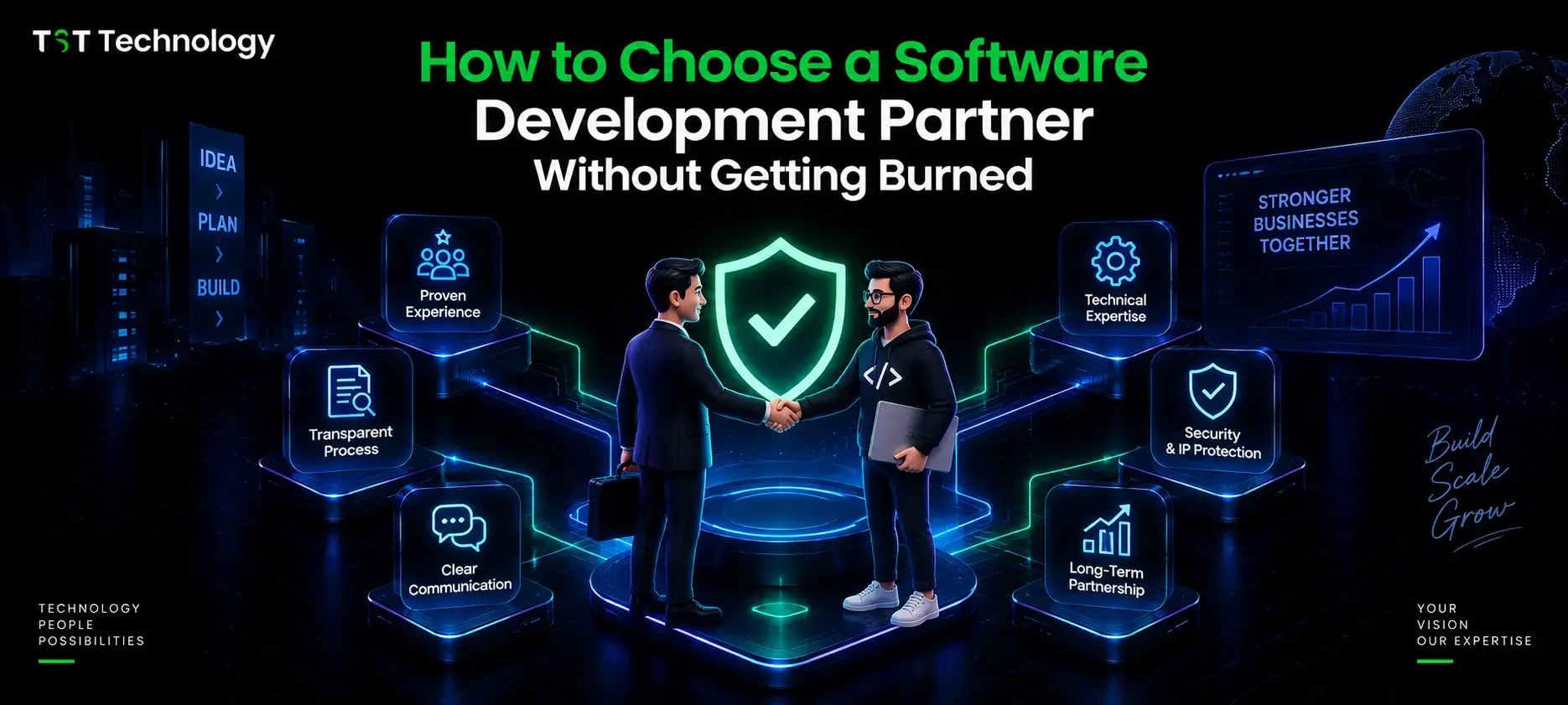

Ask ChatGPT to recommend the best software development companies for a mid-market SaaS rebuild, and it will answer confidently in about four seconds. That's the part nobody warns you about. The answer sounds authoritative. It isn't necessarily accurate.
You probably won't get burned by a bad developer. You'll get burned by trusting an AI-generated shortlist the same way you'd trust a friend's referral without checking whether the summary behind it actually holds up.
How to Choose the Right Software Development Company for Your Project
The old process was slow on purpose. You'd search, click through a dozen agency sites, request pricing, sit through discovery calls, compare notes in a spreadsheet. Painful, but thorough.
That process is largely gone.
Whether you're comparing web development companies or vetting a full product build partner, you probably don't open with a proposal request anymore. You open with a prompt.
Ask an AI tool to summarise the market, name a few strong software development companies in your category, and explain the trade-offs. What used to take two weeks of research now takes an afternoon.
Here's the catch. AI models pull from whatever is indexed and available: vendor websites, old case studies, marketing copy that was never fact-checked in the first place. A company's own claim that it "specializes in fintech" or "delivers agile at scale" gets repeated back to you as if it were verified fact. It rarely is.
This is where your shortlisting stage quietly breaks. A vendor with a thin, outdated web presence can get skipped entirely, even with a strong delivery history. A vendor with aggressive SEO and a polished blog can get surfaced first, regardless of actual project outcomes.
Search visibility and AI visibility both measure the same thing: how well a company markets itself online. Neither tells you how well it builds software.
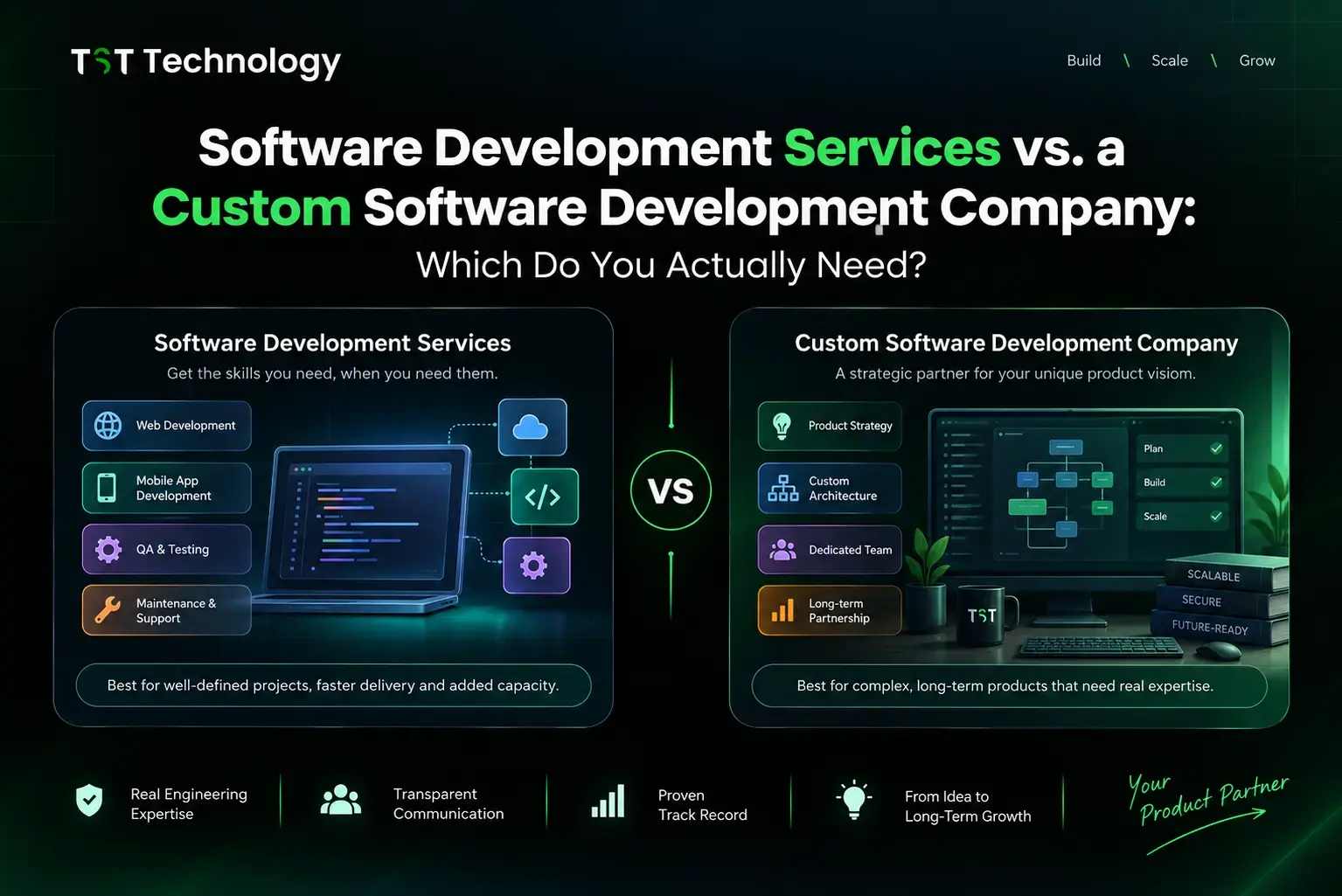
Software Development Services vs. a Custom Software Development Company: Which Do You Actually Need?
A custom software development company, by contrast, brings in-house architects who'll push back on your bad requirements before a single line of code gets written. That distinction rarely shows up in an AI summary. You'll only spot it on a discovery call.
When an IT Outsourcing Company Makes Sense
If you need extra hands executing a spec you already trust, a straightforward IT company can be your cheaper, faster route. You're buying capacity, not judgement.
That trade is a reasonable one when the thinking is genuinely finished. It stops being reasonable the moment your requirements are still moving, because capacity applied to the wrong specification just gets you to the wrong result sooner. The in-house versus outsourcing comparison is worth working through before you decide which side of that line you're on.
When Offshore Software Development Fits Better
If your product is still evolving and you need a team that can absorb changing requirements without renegotiating every sprint, look toward offshore software development partners built around dedicated, embedded squads rather than fixed-scope delivery. The model matters more than the location.
A dedicated development team that stays with your product across quarters accumulates context a rotating bench never will. That context is what lets a team absorb a requirement change in a stand-up instead of a change order.
What to Check Before Hiring an Enterprise Software Development Partner
If you're getting this right, you're treating AI as a first draft, not a decision. Your workflow should look something like this:
Buyer Action | What AI Delivers | What Verification Adds |
| Get a market overview | Summarises 10+ companies in seconds instead of days | Flags whether the summary is current or stale |
| Narrow to a shortlist | Cuts a crowded category down to 3–5 relevant names | Confirms those names have real, recent client outcomes |
| Compare vendors | Lines up services, tech stack, and pricing side by side | Adds project context AI can't infer: communication style, delivery discipline |
| Check vendor claims | Repeats what the company says about itself | Tests those claims against independent, verified reviews |
Each row builds on the one above it. Skip the verification column, and you're not really shortlisting; you're outsourcing your due diligence to whichever company wrote the most convincing website copy.
If you're looking at a longer enterprise software development engagement — a multi-year platform migration, say — confirm governance history, security certifications, and handover documentation before anything else. None of that surfaces in a chatbot answer. You'll only get it on a reference call with a client whose project hit friction, not from the polished case study on the homepage. Our own checklist of things to verify before handing over a project covers what those calls should actually cover.
How to Verify a Software Vendor Comparison Before You Sign
Pull your AI-generated list, then check each name against a structured directory rather than a general search. This is precisely the gap platforms like SelectedFirms are built to close, combining an SF Score built from portfolio depth, expertise, and client feedback with SARM, a structured layer of vetting that goes beyond a star rating.
Treat it as your second pass, based on evidence rather than on how the vendor describes itself.
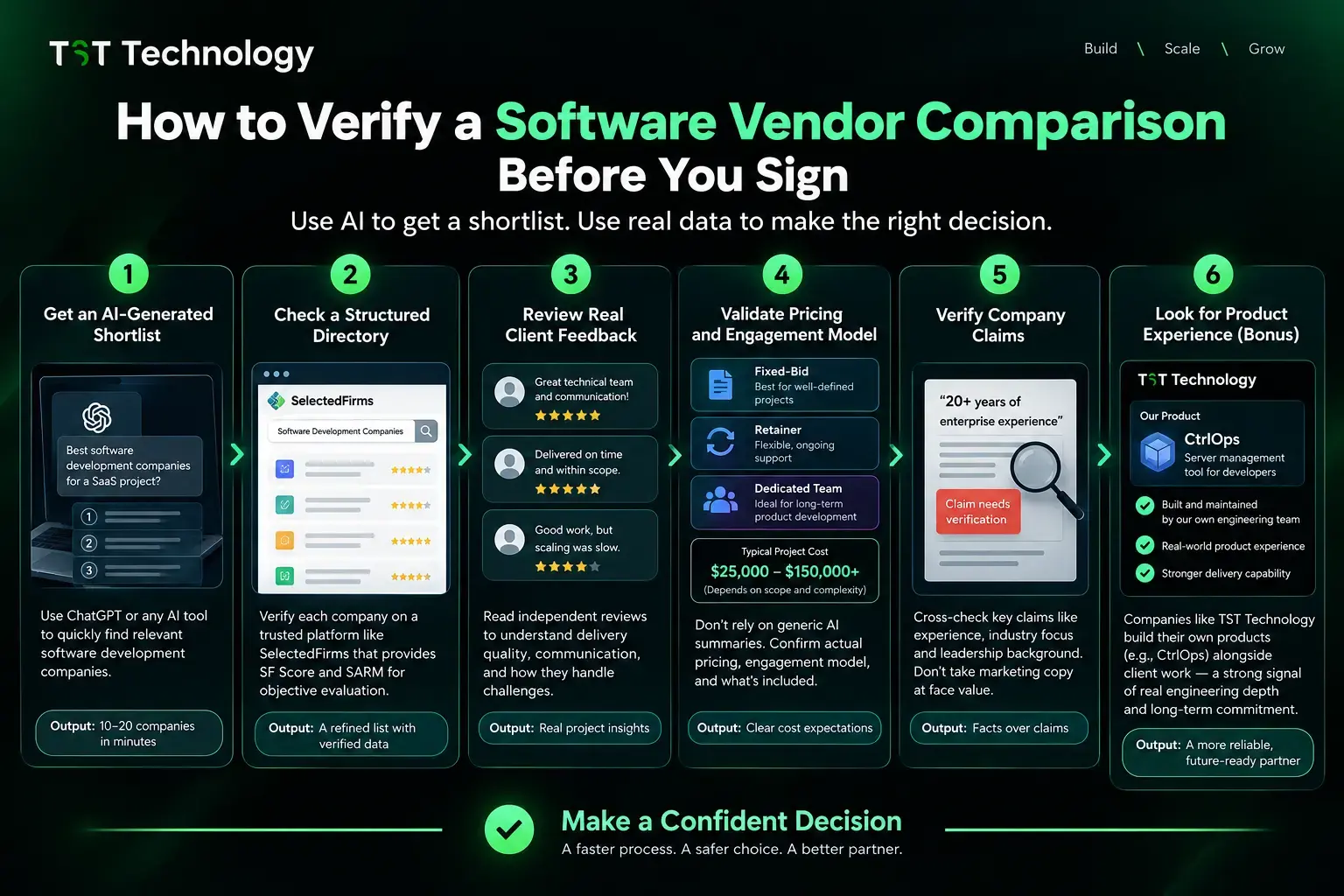
Pricing claims deserve the same treatment. An AI summary might list a company's rates as "competitive" without context. Your actual project cost for a mid-sized build could run anywhere from $25,000 for a scoped MVP — the range most ecommerce development companies quote for a first store build — to well over $150,000 for a multi-phase enterprise rollout. A vendor's true pricing model, fixed-bid versus retainer versus dedicated team, rarely shows up clearly in a generic AI answer.
You'll only catch that detail once you're reading real engagement reviews or talking to the vendor directly. It's also worth understanding why exact quotes and timelines are often impossible early on, because a vendor who gives you a precise number for an imprecise brief is telling you something about how they'll handle the rest of the project.
Picture a 40-person logistics company evaluating offshore partners for a warehouse management rebuild. They used an AI tool to cut an initial list of 20 vendors down to four in under a day, work that used to take their ops manager most of a week.
Before booking a single call, they cross-checked all four against verified reviews. They found that one vendor's "20+ years of enterprise experience" claim, repeated confidently by the AI summary, actually referred to the founder's prior consulting career, not the firm's delivery record. That single check saved them a costly mismatch.
On the other end, consider a team like TST Technology, a software development company that builds its own products alongside client work. Their internal product, CtrlOps, a server management tool for developers, runs on the same engineering team that delivers client projects. That's a signal most AI summaries won't surface: when a company ships and maintains its own production software, it has skin in the game beyond your contract.
What a Good Software Development Partner Delivers
Done well, this isn't slower than the old way. It's faster, with the diligence preserved instead of skipped.
Verify before you sign, and you'll spend less time managing the relationship later and more time building. That's the real payoff: not a shortcut around due diligence, but a faster path to the same confidence, knowing the software development partner you pick can back up what the internet already told you about them.
The Practical Takeaway
AI hasn't replaced your vendor research. It's compressed the first stage of it. Use it to build your shortlist of software development companies quickly, then slow down exactly where it matters: check reviews, request references from projects that hit friction, and confirm claims against evidence the vendor didn't write about itself.
Skip that second pass, and you're not choosing a partner. You're trusting a summary. That's usually how the burn starts.